

Entity SEO: How To Find Right Entities & Optimize In Content?

In the context of entity seo, Google has strengthen its retrieval information using Natural Language Processing (NLP) to generate accurate, personalized, and rightful information.
Previously, the Knowledge Graph Panel, Featured Snippets, and People Also Ask (PAA) were key mediums for entity optimization for brands and individuals. In fact, Google’s Knowledge Graph contains over 500 billion facts about 5 billion entities.
Since then Google MUM, SGE, and LLM have revolutionized entity retrieval and changed the arc of Search Engine Optimization.
Today’s competition is about fighting for visibility on AI Overviews which is indeed a fact that you must be produce authoritative and entity-optimized content.
I have shared an important details with SEO professionals, bloggers, and content strategists on how to find right entities and optimize in content.
Table of Contents
Entity SEO emphasizes the meaning behind words by identifying people, places, organizations, and concepts that search engines can understand and connect in a Knowledge Graph.
Entities in SEO are different from keywords as they are not address words used in query search, but entities are the singular, distinct description of things or concept used to identify search query accurately.
Example:
Take the word “Apple”—it could mean the tech company or the fruit. Google identifies each as a distinct entity based on context and background knowledge.
Search engines understand about entities by exploring the words inside Knowledge Graph, Wikidata, and Wikipedia to form a structured understanding of entities and how they relate to one another.
An important difference is that Keyword help with what users typing and Entities help what users actually mean.
Crunching the above context. Keyword are words or phrases used in searches. They can be questions, sentences, or a word. For example, “best laptop” or “best phone in 2025”
Entity, on the other hand, a word that is singular, unique, well-defined and distinguishable often categories into people, places, things, and objects. For example, “Apple Inc.” (company), “iPhone 15” (product), “Tim Cook” (person), etc. Entities are the digital representation of the “things” people search for. An entity guides search engines to understand clear and distinguish words based on their emotion.
Keywords and entities have separate importance in content. Keywords still matter because they connect your content to queries. Entities are important to help search engine understand how various words are connected and defined, focuses on semantic understanding.
Manual entity seo scraping are time taking. Therefore, I use tool-based method because convenient, less-learning curve, and efficient.
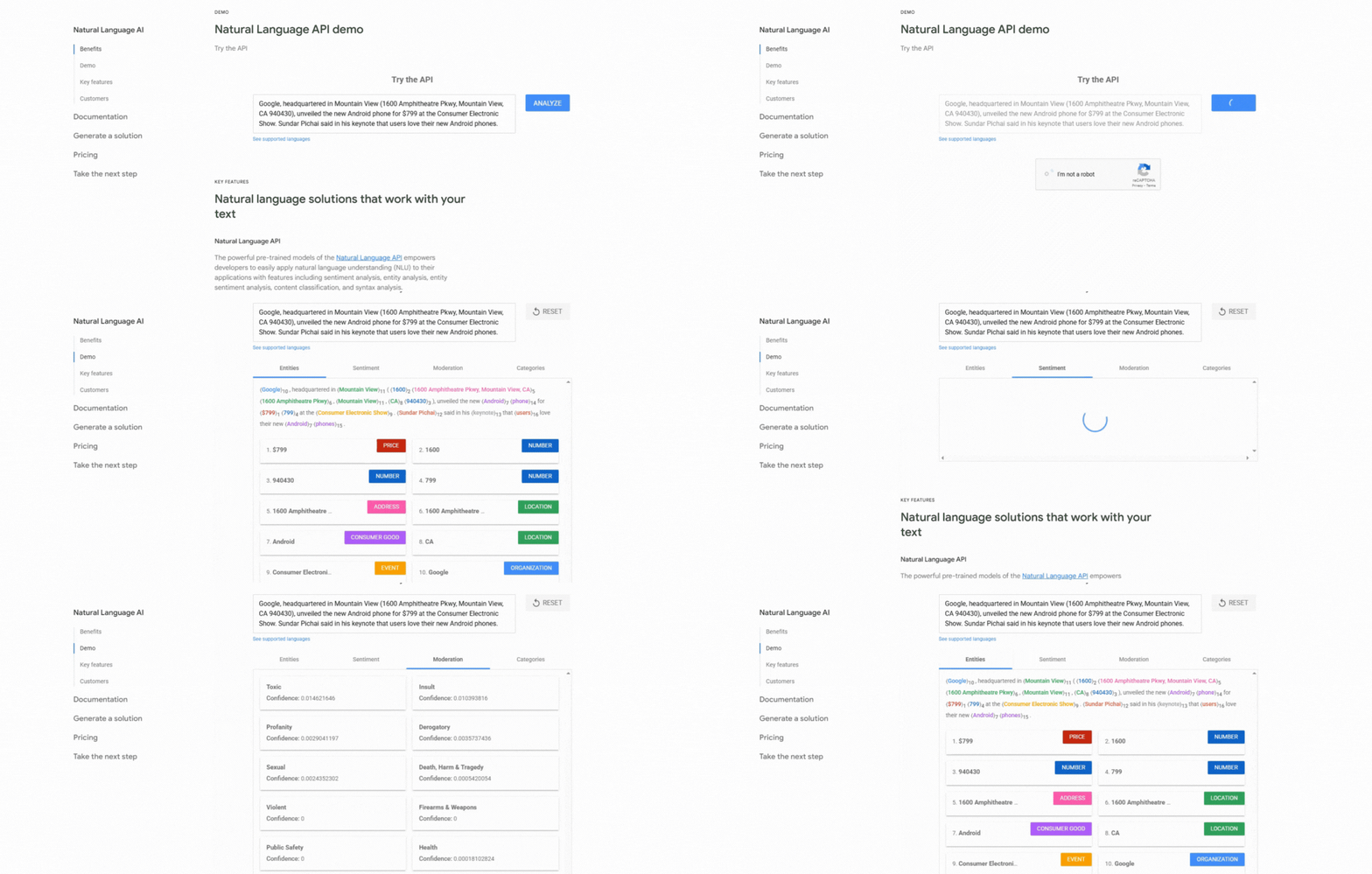
This tool analyzes your content and highlights the entities Google recognizes along with their importance, types (Person or Organization), and links to Knowledge Graph entries. It is great for understanding how Google itself interprets your content semantically.
In a conversational style, you can prompt GPT-4 to extract entities from a paragraph, identify their relationships, or even generate entity maps. It is great for quick, structured analysis of any text using natural language. You can even ask to format entities in specific style. For example, [Entity 1]–(relation)–>[Entity 2] and you can dig deeper to understand characteristic or properties of each entities to understand their relationship more better.
Also read: Costco Gas Hours: Know Everything Including Holidays, Saturdays, & Sundays In 2025Entities optimization can be done through entity mapping, refers to a series of procedure consist entity identification, entity attribution, and discover relationship.
Below I have shared a tested example of entity mapping using ChatGPT based on Topic idea “How to control temperature in a charcoal smokes?”
A. People
B. Places
C. Things
D. Concepts
1. Pitmaster / Griller / Barbecue Enthusiast
2. Grill Area / Outdoors
3. Firebox / Cooking Chamber
4. Vents (Top / Bottom)
5. Charcoal
6. Smoker
7. Thermometer
8. Chimney Starter
9. Water Pan
10. Wood Chips / Chunks
11. Air Vents / Dampers
12. Fuel (Briquettes, Lump Charcoal)
13. Temperature Control
14. Airflow
15. Heat Zones (Direct / Indirect Heat)
16. Fuel Management
17. Low and Slow Cooking
18. Temperature Spikes / Drops
A. Fuel & Heat Source Relationships
[Charcoal] –> (burns to generate) –> [Heat], [Heat] –> (increases) –> [Cooking Chamber Temperature], [Wood Chips / Chunks] –> (produce) –> [Smoke], [Charcoal] –> (placed in) –> [Firebox], [Firebox] –> (sits inside) –> [Smoker]B. Airflow & Ventilation
[Air Vents] –> (control) –> [Airflow], [Airflow] –> (controls combustion in) –> [Charcoal], [Airflow] –> (affects) –> [Heat Production], [Bottom Vents] –> (intake) –> [Oxygen], [Top Vents] –> (exhaust) –> [Smoke & Heat]C. Temperature Control
[Airflow] –> (controls) –> [Temperature], [Water Pan] –> (regulates) –> [Humidity], [Water Pan] –> (stabilizes) –> [Heat Fluctuations], [Thermometer] –> (measures) –> [Cooking Chamber Temperature], [Smoker Type] –> (influences) –> [Heat Retention], [Pitmaster] –> (adjusts) –> [Vents], [Pitmaster] –> (manages) –> [Fuel Supply]D. Cooking Process
[Cooking Chamber Temperature] –> (determines) –> [Cooking Time], [Heat Zones] –> (created by) –> [Charcoal Placement], [Meat] –> (placed in) –> [Cooking Chamber], [Pitmaster] –> (uses) –> [Thermometer], [Low & Slow Cooking] –> (requires) –> [Stable Temperature], [Stable Temperature] –> (achieved by) –> [Fuel Management], [Charcoal Type] –> (affects) –> [Burn Time and Heat Output]E. Environmental Factors
[Wind] –> (affects) –> [Airflow], [Ambient Temperature] –> (influences) –> [Heat Loss or Retention], [Outdoor Environment] –> (impacts) –> [Smoker Efficiency]F. Grill Configuration
[Smoker] –> (contains) –> [Firebox], [Cooking Chamber], [Air Vents], [Firebox] –> (holds) –> [Charcoal], [Wood Chunks], [Cooking Chamber] –> (holds) –> [Water Pan], [Meat], [Thermometer]After collecting entities, use these while drafting your content. Adding most of these entities make your draft reliable, accurate, and strong for search engines.
One of the significant benefits of entity seo is that it goes beyond keywords, making your content with how search engines and AI understand the world.
1. Stronger Topical Authority
When you consistently cover related entities in-depth, search engines recognize your site as a trusted source in your niche. This strengthens your topical relevance and improves rankings across semantically related queries.
2. Better AI Comprehension
Search engines (like Google AI Overviews) and language models (GPT-4o) use entity-based understanding to interpret content. Well-optimized entities help these systems extract accurate answers.
3. Higher Chances of Featured Snippets
Google pulls structured information from entity-rich content to display; featured snippets, knowledge panel, people also ask, and carousels (FAQs).
Optimizing content based on entities parameters is a great way to show authority, expertise, and trust to search engine and get higher ranking than your competitors. A few more consideration while optimizing for entity SEO.
Though, entities optimization is not an easy task, it takes time, knowledge, and hard work. As I am learning more on Generative Engine Optimization and GenAI – I’ll keep updating this post for up-to-date information.
In the end, I do recommend seo professionals, seo writers, and content strategist to use entity seo in their content. Also, I would love to hear your thoughts. Thanks for reading 🙂
It helps search engines and AI tools better understand your content, improves topical authority, and increases your chances of ranking in featured snippets, Knowledge Panels, and Google SGE results.
Yes. Since the introduction of the Knowledge Graph and Hummingbird update, Google increasingly focuses on semantic search and entity understanding.
Yes, keyword optimization still important to address queries and entities to help search engines understand relationship across queries accurately.
You can use Schema markup (like Person, Organization, Product, or Article) to help search engines understand the entities mentioned on your page.
Disclaimer: The information written on this article is for education purposes only. We do not own them or are not partnered to these websites. For more information, read our terms and conditions.
FYI: Explore more tips and tricks here. For more tech tips and quick solutions, follow our Facebook page, for AI-driven insights and guides, follow our LinkedIn page.
Update Timelines:
August 11, 2025 – Added important suggestions in the conclusion.
Tuesday August 12, 2025
Friday July 4, 2025
Thursday June 12, 2025
Tuesday June 10, 2025
Wednesday May 28, 2025
Monday March 17, 2025
Tuesday March 11, 2025
Wednesday March 5, 2025
Tuesday February 11, 2025
Wednesday January 22, 2025

High-quality market intelligence is precious, fragmented, and often locked..

If your legacy Java application collides with large datasets, batch processing..

Customer support systems are designed to streamline communication, decrease..

Personalised PAT test labels are crucial elements in maintaining compliance and..

In today’s retail environment, in-store execution has become one of the most..

Paid guest posting is commonly positioned as a fast-track solution to enhance..